Syntaxe · a systems lab

Syntaxe is a technology company: a systems lab building inspectable computational engines for security, law, science and critical infrastructure, plus an engineering practice for organisations solving difficult technical problems.

Reach the lab at hello@syntaxeltd.com · Syntaxe Ltd.

move · it knows you're here
Syntaxe Ltd  ·  Building advanced computational systems for complex domains
Syntaxe Ltd · the lab

A systems lab.

The Lab is Syntaxe’s research and engineering core. We turn difficult, fragmented domains into computational systems that can be inspected, tested, and used. Our work spans security, law, science, biology, and critical infrastructure, built from evidence, formal models, and domain constraints rather than fluent approximation.

scroll · the thesis, the systems, the lines we hold ↓
the thesis

Complex domains need more than answers.

An answer is useful only when its sources, assumptions, authority, and limits remain visible. We build systems that make those structures explicit: the state of the problem, the rules that govern it, the evidence supporting it, and the path from input to result.

Where formal proof is possible, the system supplies it. Where proof is not possible, it exposes uncertainty, preserves the evidence, and returns the decision to a human.

Engineers reviewing a verification run against a wall display in the Syntaxe lab.
the lab · a verification run, reviewed
the depth

Different disciplines. One way of building.

Every Syntaxe engine is built around the same underlying primitives.

State
Constraint
Provenance
Verification
Observability
Human authority

Each system belongs to its own domain. The following systems are ready for public examination.

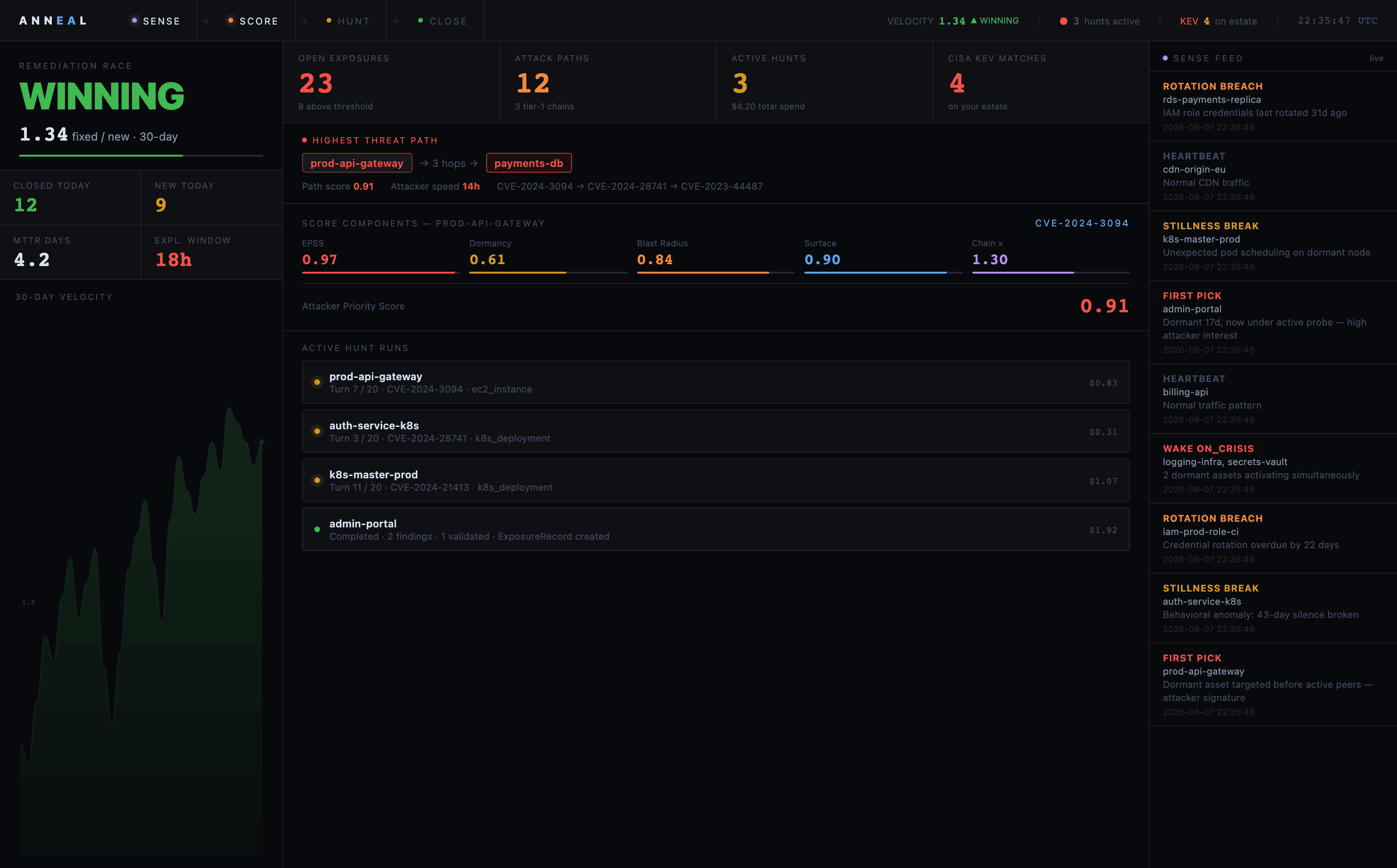
SOVEREIGNevidence-led legacy modernisationStart with a bounded, source-led assessment of supplied COBOL and associated artefacts. Receive a reviewed inventory, explicit constraints and a recommendation for what to verify next. A separate Verification Pilot tests a reconstructed cohort against an agreed executable reference.modernisation assessment · verification pilot · explicit evidence boundariesenter →KERNprovable containment for agent systemsKERN compiles an agent mesh’s declared tools, data labels, and authority boundaries into a runtime monitor and a re-checkable certificate. It can reject forged certificates, identify unauthorised routes, and produce a concrete counterexample when a permitted path violates policy.working demonstrator · portable proof certificate · independently re-checkableenter →AWATUMcomputable legal stateAWATUM models facts, rights, obligations, evidence, procedure, deadlines, and authority as one evolving legal state. Its outputs remain linked to primary sources, visible reasoning, and the human approvals required before legal action is taken.live operating system · graph-native engines · five perspectives, one systementer →VERITYscientific claims, examined against their evidenceVERITY evaluates claims across statistical, textual, image, methodological, data, reference, and provenance signals. It identifies what requires expert examination, shows the supporting evidence, and preserves the distinction between a warning signal and a verdict.working engine · seven verification axes · traceable methodsenter →ANNEALsecurity that attacks its own assumptionsANNEAL continuously models reachable attack paths, tests them, identifies material weaknesses, and re-runs the model after remediation. It is designed to prioritise the small number of actions that materially change exposure rather than generate another undifferentiated alert stream.continuous adversarial testing · reachable-path analysis · evidence-ranked alertsenter →CODECbiology as a dynamic computational systemCODEC is a research platform exploring genomic regulation, cell-state stability, differentiation, and phenotype as dynamics over a structured state space. It treats the genome not merely as a sequence to catalogue, but as a regulatory system whose behaviour must be modelled and experimentally tested.computational genomics · dynamical-systems framework · research-stageenter →
syntaxe engineering

Research becomes capability.

Syntaxe engages commercially, today. We apply the same systems discipline used inside the Lab, explicit state, tested behaviour, evidence over confidence, to technically difficult work for organisations that need more than an off-the-shelf product.

software & platforms · cloud & infrastructure · cybersecurity & network security · digital products & interfaces · AI integration · computational systems · research & technical validation

Engagements begin with a scoping conversation, not a sales process.

An engineer reviewing system behaviour late at night.
the lab · behaviour, examined
why now

More systems are becoming operational before they are becoming understandable.

Operational systems are becoming more interconnected and consequential. Autonomous systems are gaining authority. Scientific evidence is growing faster than it can be examined. Specialist domains remain fragmented across documents, tools, datasets, and institutional memory.

Systems like these are being given authority faster than anyone can inspect them. That is the gap Syntaxe builds into.

Syntaxe’s advantage is not access to a model. It is the domain architecture, evidence structures, verification discipline, and engineering accumulated inside each system.

what we hold to

The lines we do not cross.

Proof where proof is possible. Evidence everywhere else.
We do not relabel confidence as certainty. Every material claim must trace to evidence, a formal result, or an explicit statement of what remains unknown.
Human authority remains visible.
Each system declares where its authority ends. It may analyse, model, warn, or recommend. It does not quietly replace the human judgement that must remain human.
Limits are part of the output.
A system that cannot identify uncertainty is not ready for consequential use. Unknown is a valid result.
Built to survive handover.
We build systems to remain inspectable, maintainable, and accountable throughout their operational life.
We build slowly enough to understand what we are shipping, and rigorously enough that another person can examine how it works.

We put a system in public when it can be tested, not when it can be announced. For technical work, research collaboration, or strategic partnership, there is a direct route into Syntaxe.

syntaxe ltd · a systems lab
Syntaxe Ltd · engineering services

Research becomes capability.

Syntaxe engages commercially, today. We apply the same systems discipline used inside the Lab, explicit state, tested behaviour, evidence over confidence, to technically difficult work for organisations that need more than an off-the-shelf product.

what you can commission

Choose the work. Know what you receive.

Start with the decision or system you need to move forward. We agree the scope, evidence available, output and acceptance criteria before work begins.

Technical assessment

Bring a system, technical claim or acquisition target and a defined question. Receive written findings linked to the material reviewed, with material risks, unknowns and a recommended next verification step.

fixed scope · agreed schedule · written findings
Systems build

Agree the first phase and its acceptance criteria. Each phase ends with a working increment, the checks run against it and handover material, so the next decision rests on what was delivered.

three months upward · phased · a working result per phase
Retained advisory

Bring decisions your team owns: architecture, delivery risk or work in flight. Receive an independent review of options, tradeoffs and open questions, recorded for the people who must act on them.

monthly · ongoing · cancellable
what we do

Seven lines of work. One standard.

We take on technically difficult work for organisations that need more than an off-the-shelf product. Whichever line the work sits in, it is delivered the same way: explicit state, tested behaviour, and documentation another engineer can pick up without us in the room.

Software & platforms

We design and build software from a blank page or inside an existing codebase: enterprise platforms, internal tools, APIs, and the integrations that connect them. Delivery follows the same discipline as the Lab’s own engines: explicit state, tested behaviour, and documentation another engineer can pick up without us in the room.

custom builds · platform extension · API & integration design
Cloud & infrastructure

We design and operate the infrastructure underneath a product: architecture, deployment pipelines, observability, and the resilience work that keeps a system up when it matters. Migrations are planned around the business’s actual risk tolerance, not a vendor’s roadmap.

architecture & migration · deployment automation · observability & resilience
Cybersecurity & network security

We assess and harden the systems an organisation already runs: architecture review, identity and access design, network segmentation, and the monitoring that turns an incident into a contained event instead of a headline. Findings are prioritised by what is actually reachable, not by a generic severity score.

architecture review · identity & access · monitoring & hardening
Digital products & interfaces

We take a product from a rough idea to something a real user can hold: interface design, a design system that survives more than one release, and the engineering to ship it. The same craft standard visible on this site is the standard we bring to a client’s.

concept to launch · design systems · production engineering
AI Integration

Connect AI capabilities to existing applications, data and workflows for a defined task. We scope what the system may access and do, build the integration, evaluate it on agreed cases, and make human review and fallback explicit where the work is consequential.

application integration · workflow design · evaluation & controls
Computational systems

For problems that do not fit off-the-shelf software, we build the engine itself: simulations, decision-support systems, and analytical infrastructure modelled on the domain’s actual constraints, not a generic template. This is the same discipline behind the Lab’s own engines, scoped to a client’s exact problem.

bespoke engines · simulation & modelling · decision-support systems
Research & technical validation

We act as an independent technical assessor: reviewing a system, a claim, or an acquisition target on its merits, and stating plainly what holds up and what does not. This is the same evidentiary standard VERITY applies to a scientific claim, applied to a commercial decision.

technical due diligence · independent assessment · research collaboration
our own systems, open to inspection

See the method in the work.

These are Syntaxe systems, not examples of completed client engagements. They show how we define a boundary, expose evidence and state what remains unverified.

Three Syntaxe engineers working through a system architecture on a printed wall.
syntaxe engineering · an architecture, worked through
A scoping conversation across a table, a printed document between the two people.
syntaxe engineering · where every engagement starts
how it starts

A conversation, then a written scope.

One
A scoping conversation. You describe the problem. We tell you honestly whether it is ours to solve, and say so if it is not.
Two
A written scope: what we will do, how long it runs, what you receive, and what falls outside it. Nothing begins on a handshake and an assumption.
Three
The first phase begins. You see working output at its boundary, not at the end of everything.

You will have the shape and the cost of the work in writing before you commit to any of it.

what we hold to

Clear terms. Clear boundaries.

We tell you when it is not ours.
If the problem is better solved by an existing product, a different discipline, or nobody at all, that is what the scoping conversation will say. We would rather lose the work than take it badly.
Built to survive handover.
What we build stays inspectable and maintainable after we leave. You should never be held hostage by the only people who understand your own system.
Findings are not softened.
An assessment reports what we found, including the parts that are inconvenient and the parts we could not determine. Unknown is a valid result and it will be written as one.
Confidentiality and rights are agreed in writing.
The agreement identifies your deliverables and usage rights, and the underlying Syntaxe tools or platform IP that remain ours. We do not publish your name, system or findings without permission.
The fastest way to find out whether we are right for the problem is to describe the problem.

Start with a conversation about your objective. We will agree the fit, scope and next step with you.

syntaxe ltd · engineering services
Syntaxe Ltd · careers

Build systems that matter.

We look for engineers who combine technical depth with delivery and ownership. Model difficult problems, build useful systems, verify the result and leave work that another team can understand.

Tell us about your experience. Share work you can discuss, how you approached it and what you would like to build next.

Send an expression of interest →
the work

Problems that stay unsolved because they are genuinely hard.

Syntaxe builds computational systems for domains where being wrong is expensive: security, law, science and critical infrastructure. The work is modelling a domain properly, then proving the system behaves as claimed, then stating plainly where it stops.

We work towards clear delivery milestones, with verification and handover built into the plan. Ownership means making progress visible, raising risks early and showing that the delivered system meets its agreed requirements.

An engineer annotating a printed specification at a desk late at night.
the lab · a specification, read properly
how we work

The standard is the same for everyone.

Proof beats opinion.
Disagreements are settled by going and checking, not by seniority. Being wrong quickly is fine. Being confidently unverified is not.
You own the whole thing.
Not a ticket queue. You take a problem from the domain modelling through to the verification and the handover, and your name is on how it behaves in production.
Depth with delivery.
Break difficult work into useful, verifiable steps. Agree the boundary, deliver against it, and make limitations clear before they become someone else’s problem.
Written down, or it did not happen.
Everything is built to survive the person who built it leaving. That discipline is not bureaucracy here, it is the product.
who this suits

Ownership, judgement and collaboration.

Suits
People who go and read the specification. Who are drawn to a domain rather than a stack. Who combine careful reasoning with delivery, and welcome examination of their work.
The environment
A focused company with broad ownership. We discuss responsibilities, support and delivery expectations during the hiring conversation so both sides understand the role.
Openings
No role is currently listed. An expression of interest starts a conversation, not an application to a live opening.
Your work
Public work, a technical explanation or a non-confidential account of a difficult project can help us understand your contribution. Do not disclose an employer’s private material.
how to approach us

Show us your experience. And how you think.

A CV tells us where you have been. We also want to understand how you think when the problem is difficult, the path is unclear and the work is yours to own.

Send a CV and a relevant, non-confidential example of your work. If the underlying work is private, a short technical explanation is welcome. You can also describe a problem you would like to tackle.

One
Share your experience, interests and relevant work so we can consider the fit with current needs.
Two
We talk about the problem itself, not rehearsed competencies. Expect to be pressed on your assumptions, tradeoffs, failure modes and what you do not yet know.
Three
A small, paid piece of real work. Both sides learn how the other thinks, builds, communicates and handles uncertainty before making a longer commitment.

There is no listed opening at the moment. You can send an expression of interest, but there is no live role attached to it.

Show us the work you can discuss and the problems you want to own.

If that is you, tell us about your experience and the work you would like to take on.

syntaxe ltd · engineering with ownership
Syntaxe Ltd · contact

Let’s discuss your next step.

Explore a product, discuss an assessment or scope an engineering engagement. Tell us what you want to achieve; we can establish the fit, scope and next step together.

Email Syntaxe →hello@syntaxeltd.com
pick the one that fits

Start a conversation. Choose what you need.

Use the route that best matches your enquiry. If you are unsure, start with Products & engineering. Please do not send source code, credentials or confidential customer data in your first email.

Products & engineering hello@syntaxeltd.com

Explore a Syntaxe product, discuss an AI integration or Sovereign assessment, or scope an engineering engagement. Tell us what you need to achieve and what you have today.

Engineering Services →
your organisation · the product or problem · your intended outcome

You invest in deep technology and want the materials, or a conversation with the person who built the systems rather than someone briefed on them.

For investors →
your fund or vehicle · stage and cheque size you write · what you would need to see
Research & press press@syntaxeltd.com

You want to collaborate on research, examine a claim we have made, or write about the work. Claims we publish are meant to be checked, and we would rather help you check them properly.

the claim or system in question · your deadline · what access you need

There is no listed opening at present. You can send an expression of interest for future roles. Our process includes a small, paid piece of real work for candidates moving forward.

Careers →
your CV · a non-confidential work example or technical explanation · the work you want to do

Institutional collaboration, distribution, or bringing a Syntaxe system into a domain we do not yet reach.

the organisation · the domain · what the partnership would make possible
An engineer reading a message at her desk, unhurried.
syntaxe · a message is read by the person who built the thing
what happens next

Your objective first. Then the right next step.

We begin by understanding your objective, the system involved and any delivery constraints. From there we can discuss product fit, an assessment or a scoped engineering engagement.

Before work begins, we agree the scope, deliverables, fee and access arrangements. Where sensitive material is needed, we agree how it will be shared before you supply it.

Tell us what you want to achieve. We can work out the next step together.
syntaxe ltd · united kingdom
Syntaxe Ltd · investors

The method is the asset.
The systems are the proof.

Syntaxe builds computational systems for domains where evidence, authority and correctness matter: security, law, science and critical infrastructure. Six systems, one method, and an engineering practice applying the same discipline commercially. Everything claimed on this page can be checked before you decide anything.

A direct conversation Meet the people behind the systems. Tell us what you want to explore and suggest a time. We will arrange it directly.
what the company is

Not six bets. Six instances of one method.

A portfolio of unrelated products would be a reason to pass. These are not unrelated. Every Syntaxe system is built from the same six primitives, applied to a different domain: explicit state, the domain's real constraints, provenance carried with every claim, verification where verification is possible, observability from outside, and a declared boundary where human authority begins.

The method is the asset. The systems are the evidence that it transfers. Shared machinery for evidence, verification and explicit limits is intended to support reuse across domains. The cost and value of that reuse must be established in delivery.

State
Constraint
Provenance
Verification
Observability
Human authority
what exists today

You do not have to take our word for any of this.

Each system below declares its own maturity stage in its own words. Nothing is described as further along than it is, and where a system is early we say so rather than dressing it as a product. Follow any of them and examine the work directly.

SOVEREIGNevidence-led legacy modernisationStart with a bounded, source-led assessment of supplied COBOL and associated artefacts. Receive a reviewed inventory, explicit constraints and a recommendation for what to verify next. A separate Verification Pilot tests a reconstructed cohort against an agreed executable reference.modernisation assessment · verification pilot · explicit evidence boundariesenter →KERNprovable containment for agent systemsKERN compiles an agent mesh’s declared tools, data labels, and authority boundaries into a runtime monitor and a re-checkable certificate. It can reject forged certificates, identify unauthorised routes, and produce a concrete counterexample when a permitted path violates policy.working demonstrator · portable proof certificate · independently re-checkableenter →AWATUMcomputable legal stateAWATUM models facts, rights, obligations, evidence, procedure, deadlines, and authority as one evolving legal state. Its outputs remain linked to primary sources, visible reasoning, and the human approvals required before legal action is taken.live operating system · graph-native engines · five perspectives, one systementer →VERITYscientific claims, examined against their evidenceVERITY evaluates claims across statistical, textual, image, methodological, data, reference, and provenance signals. It identifies what requires expert examination, shows the supporting evidence, and preserves the distinction between a warning signal and a verdict.working engine · seven verification axes · traceable methodsenter →ANNEALsecurity that attacks its own assumptionsANNEAL continuously models reachable attack paths, tests them, identifies material weaknesses, and re-runs the model after remediation. It is designed to prioritise the small number of actions that materially change exposure rather than generate another undifferentiated alert stream.continuous adversarial testing · reachable-path analysis · evidence-ranked alertsenter →CODECbiology as a dynamic computational systemCODEC is a research platform exploring genomic regulation, cell-state stability, differentiation, and phenotype as dynamics over a structured state space. It treats the genome not merely as a sequence to catalogue, but as a regulatory system whose behaviour must be modelled and experimentally tested.computational genomics · dynamical-systems framework · research-stageenter →
commercial model

Engineering services. Product-led engagements.

The commercial model combines scoped engineering work with product-specific assessments, pilots and deployment opportunities. This describes the routes to market, not a statement of realised revenue or customer traction.

Services
Scoped engineering engagements for organisations that need more than an off-the-shelf product, with agreed deliverables and commercial terms.
Systems
Product-specific entry points, including Sovereign assessments and Verification Pilots. Licensing and deployment arrangements depend on product maturity and customer requirements.
The loop
Customer work can inform product development, while the systems demonstrate our approach. Current financial performance and pipeline belong in separately reviewed investor materials.
The Syntaxe studio floor in daylight, engineers at work at their desks.
syntaxe · the practice that funds the lab
Two engineers inside a large industrial plant room, dwarfed by the machinery they are examining.
the systems that cannot be switched off
why now

Capability is arriving faster than the means to trust it.

Autonomous systems are being handed authority over money, data and infrastructure. Scientific evidence is being produced faster than it can be examined. Legacy estates that cannot be switched off are being modernised on promises rather than proof. Regulation in every one of these areas is moving from principle to obligation.

The market has spent a decade buying capability. It is starting to have to buy assurance as well, and assurance is difficult to retrofit onto a system that was never built to be inspected. Syntaxe builds for inspection first, which is a head start in that shift rather than a guarantee about it.

what compounds

The advantage is not access to a model. Anyone can rent that.

Domain architecture
The structure of a legal matter, a scientific claim, an agent mesh, or a legacy estate, modelled properly. Each domain requires specialist modelling, explicit assumptions and independent examination.
Proof infrastructure
The rigs, oracles and harnesses that let a claim be verified rather than asserted. Expensive to build, invisible from outside, and the reason a Syntaxe claim can be re-checked by someone who does not trust us.
Evidence structures
The machinery that carries provenance, uncertainty and authority through a system instead of discarding them at the first transformation. Reused by every engine we build.
Verification discipline
An institutional habit of proving before claiming. It is cultural, it is slow to acquire, and it is the hardest of these four for a competitor to buy.
the team

Founder led. Built for leverage.

Syntaxe is built around a focused senior core, supported by specialist engineering capacity where each system demands it. This structure has allowed us to work from first principles, protect the integrity of the architecture, and direct expertise toward defined technical obligations rather than headcount for its own sake.

The product pages show the systems and their stated evidence boundaries. SOVEREIGN, AWATUM, VERITY and the wider Syntaxe systems have been developed through a disciplined model in which claims are earned, evidence is preserved, and complexity is added only when the work requires it.

Investment expands the depth, velocity and institutional capacity needed for the next stage: additional engineering against named systems, stronger customer deployment capability, formal verification depth, security and assurance, and the commercial operations required to take proven systems into regulated enterprises.

We will grow deliberately, but not timidly. Every addition must increase what Syntaxe can prove, deliver or support.

what capital unlocks

Technical proof, converted into institutional capacity.

Investment converts technical proof into institutional capacity: deeper engineering, customer deployments, formal verification, enterprise assurance and commercial execution. These are proposed areas of investment, not a claim of completed customer deployments.

Engineering depth
Specialist capacity added against named systems, so the programmes advance in parallel rather than in sequence.
Customer deployment
The capability to put a proven system inside a customer's estate and support it there, which is a different discipline from building it.
Verification and assurance
Formal verification depth, security and the assurance evidence a regulated enterprise requires before it will accept a system at all.
Commercial scale
The commercial operations required to take systems that already hold up into regulated enterprises at volume.
You receive
Round size, structure and terms. The commercial pipeline and its current state. Milestones the round is priced against, and what happens if they slip.
And
A technical appendix per system: what is built, what is proven, what is claimed but not yet proven, and how to verify each one yourself.
When
We agree the relevant materials, confidentiality arrangements and next steps with you.

If you would rather start by pressure-testing a system than by reading about one, say so and we will do that instead.

what would falsify this

The risks we would raise if we were you.

A company whose entire thesis is that limits belong in the output should be willing to state its own. These are the questions we would press hardest on, and we would rather answer them in the first meeting than the fourth.

Breadth
Six domains is a lot for a company this size. The counter-argument is the shared method, and it is a claim we expect to be tested rather than believed.
Sales cycles
The buyers who most need verifiable systems are also the slowest to procure them. The engineering practice exists partly so that this cycle is survivable.
Organisational depth
A compact senior core is efficient and it is also a dependency. Building the institutional depth to carry deployment, assurance and support at scale is explicit work this round funds, not something we expect to happen on its own.
Timing
The move from buying capability to buying assurance is visible but not complete. If it stalls, the systems are early rather than wrong.
Everything on this page can be checked before you decide anything. That is the point of building it this way.

The materials cover round size, structure, milestones and the commercial pipeline. Or start by going through a system with the person who built it.

syntaxe ltd · a systems lab and an engineering practice
Syntaxe Ltd · archive

Not a blog.
An archive.

Notes, observations and field reports from inside the lab: the thinking as it happens, kept as it was written. An evolving body of work, not a feed.

more, as the work accrues
These are working notes, not announcements. They are published when the thinking is worth reading, not on a schedule.

If a note raises a question, or you want to examine a claim made in one, the fastest route is to ask directly.

syntaxe ltd · the archive
subsystem online · syntaxe reasoning core
← back
SYX·VRT · syntaxe reasoning core
VERITY
defend what is true
subsystem online · scientific claim verification
scroll ↓
For people accountable for what gets published

A paper deserves
more than a score.

A reported result can look sound until a reviewer checks the calculation, follows the citation or examines the figure. Verity helps the team find those questions and keep the source in view.

Bring a defined set of manuscripts or published papers. We will show which checks the supplied material supports, what each signal means and what still requires scientific judgement.

For editorial teams, research integrity offices and R&D evidence reviewers.

REVIEW FILE / ILLUSTRATIVE01 / 03

What should a reviewer open first?

Reported resultCan the stated numbers be reproduced from the paper?Check the reported relationship where enough inputs are available. Record the missing inputs otherwise.
Supporting sourceDoes the cited material support this claim?Follow the reference, its availability and the specific statement being supported.
Editorial decisionWhat needs a person?Review a flagged signal in context before requesting clarification or making a decision.

Illustrative workflow. No manuscript result is shown.

The review desk

Three questions that change
what happens next.

01 / Statistics

Do the reported values agree?

Recheck supported arithmetic and statistical relationships. An absent input should remain an open question, never a clean pass.

02 / References

Is this the source of the claim?

Trace a statement to the cited material and inspect whether the reference exists, is accessible and says what the paper attributes to it.

03 / Figures

What deserves a closer look?

Use image analysis to direct human inspection of available figures. An unusual pattern is a review signal, not evidence of misconduct.

Beyond an isolated flag

Follow what the claim
depends on.

Verity's proof graph connects extracted claims, cited evidence and the relationships between them. A reviewer can ask whether a concern stays local or affects a conclusion elsewhere in the paper.

The graph organises the trail. It does not make a scientific claim true by drawing a line between two statements.

  1. 01 / SOURCEThe cited resultOpen the material a statement relies on.
  2. 02 / CLAIMThe statement in the paperInspect the extracted relationship and any uncertainty.
  3. 03 / DEPENDENCYThe later conclusionSee what merits another review if the premise changes.
The source stays in view

Find the question.
Show the trail.
Let the reviewer decide.

An evaluation a real team can run

Start with the papers
you already need to examine.

A bounded paid evaluation should answer a practical editorial question: does this workflow help your reviewers find material issues and explain why they matter?

We agree the paper set, permissions, supported checks, report format and acceptance criteria before the work. Send no unpublished manuscript by email at first contact; confidential transfer is agreed separately.

Scope the review with us →
INPUTDefined corpus and review owner

Paper versions, available supporting materials and the question your team must answer.

WORK PRODUCTSource-linked findings

What was checked, where each signal came from and which checks could not run.

HUMAN GATEReviewer follow-up

Interpretation, questions for authors and a decision on whether the workflow merits wider use.

The limit matters

A signal is not
a verdict.

A failed check does not establish misconduct. A completed check does not establish that a paper is true.

Extraction errors, inaccessible references, unavailable data and method-specific limits must be visible to the reviewer. Scientific and editorial decisions stay with the accountable people.

Illustrative integrity profile

Invented example. This animation is not a live manuscript analysis or a scientific verdict.

Put the review question on the table

Which claim would you
want to check first?

Tell us what your reviewers are trying to establish and what evidence they can examine.

Discuss an evaluation →
SYX·AWT · syntaxe reasoning core
AWATUM
justice, for everyone
subsystem online · computable legal state
scroll ↓
A working legal operating system

Your legal world is moving.
Awatum moves with it.

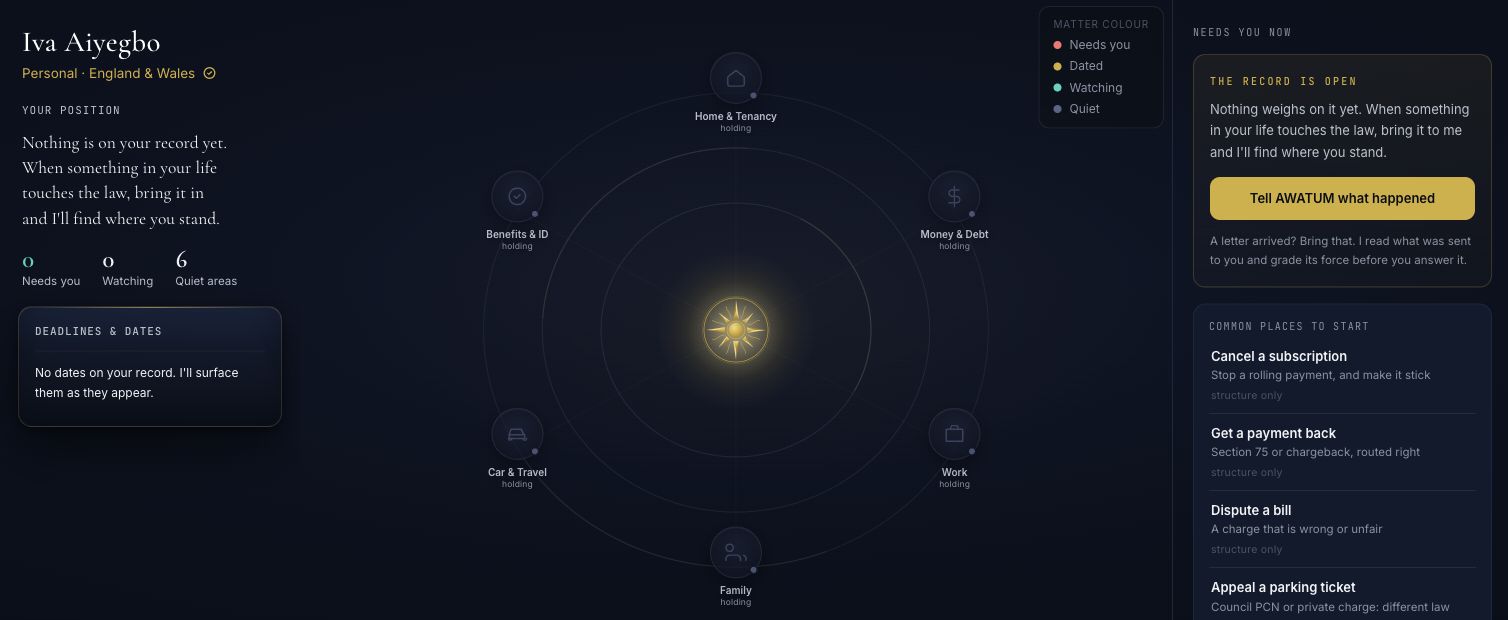
A living view of the matters, duties, documents and dates that shape your life, your company or your practice. Awatum keeps the context connected, shows what needs attention and helps you act on it.

Tell Awatum what happened. It asks for the facts that matter, shows the routes in play and the questions still open, then helps you prepare the work. When a date, document or circumstance changes, the matter remains yours to revisit and move forward.

For your life, your business and your practiceBuilt around continuing legal state
Awatum personal workspace at the start of a legal record, with its legal-life map and places to begin a matter
A continuing record

People, facts, evidence and documents stay with the matter.

A position you can examine

Possible routes, missing facts, key dates and sources remain visible.

A way to act

Prepare a document, follow a duty or bring a clearer record to a professional.

From first account to next move

Not a one-off answer.
A matter that keeps its memory.

A problem rarely arrives with every fact and document in order. Awatum gives it a place to live, then lets your position develop as the record grows.

01 / OPEN THE MATTER

Tell it what happened.

Start with your own account. Awatum separates what you have reported from what still needs checking, and asks questions that sharpen the position.

02 / SEE THE POSITION

Know what is in play.

See possible legal routes, what each may require, the other side's possible response, relevant sources and dates that need confirming.

03 / PREPARE THE WORK

Make the next move tangible.

Build a letter or other document from the matter, review the bracketed facts and outstanding checks, then save it with the record.

04 / STAY WITH IT

Return when life changes.

Add a reply, document, new fact or date. The matter keeps its history, so the next decision begins with the context already in place.

The founder workspace

Build the company.
Keep hold of its commitments.

Every contract, hire, contractor, customer promise and investor conversation can change the company's position. Awatum connects the duties, documents, dates and open questions around those decisions, so you can see what needs doing next.

Your business at a glance

One company.
Decisions that connect.

A contractor agreement can determine who owns what you build. A customer contract can change your exposure. Awatum gives those decisions a continuing business record instead of leaving them scattered across inboxes and memory.

  • What have we promised?
  • Who owns what we build?
  • Which dates matter?
  • What is still missing?
  • What can we prove?
01 / KNOW

Find out what applies.

Your company profile sharpens the picture. Awatum separates duties that apply, may apply or do not currently apply, and asks for the detail that resolves an unknown.

02 / DECIDE

Examine the commitment.

Check a contract before signing or open a matter around a live situation. See the questions, supporting material and next step together.

03 / PREPARE

Close the document gaps.

See which core documents are missing, then work in a founder Studio built for contracts, governance, fundraising, IP, data and customers.

04 / REMEMBER

Keep the dates and the proof.

Record a filing date, follow an ongoing duty, mark work complete and keep evidence with the business record.

For the decisions that do not wait for a legal department.
Start with the company, its obligations and one issue you need to move forward.

Request a founder walkthrough →
Five seats, one connected legal record

The right view for
the decision you own.

Awatum changes with the work. The individual follows a legal life. The founder steers a company. Associates, partners and firms each see a different part of a matter's path.

FounderThe business, its obligations and the decisions that shape it.Explore the founder seat ↑
01
Individual

Your legal life, in view.

Follow matters across home, work, money and family. See dates, duties, legal updates and documents, then open the detail when something needs you.

Know what is happening and what to do next.
Explore personal access →
02
Associate

Prepare the matter with its sources intact.

Work through the caseload, research a point of law, map procedure and build drafts against a matter before sending work up for review.

Preparation that can be examined and revised.
Discuss a team evaluation →
03
Partner

See what needs your judgment.

Review work for sign-off alongside deadlines, conflicts, client decisions and supervision across your own book of matters.

The decision and its basis, together.
See the partner workspace →
04
Firm

See the institution, not just its files.

Follow risk and unresolved work across the book. Record the authority behind decisions and require evidence before an assurance output can be made.

Governance that shows its working.
See the firm workspace →
A record that outlasts one conversation

The situation changes.
The record grows.
You keep your bearings.

Return to the same matter with the facts, dates and work already together.

Inside the document studio

The draft knows
which matter it belongs to.

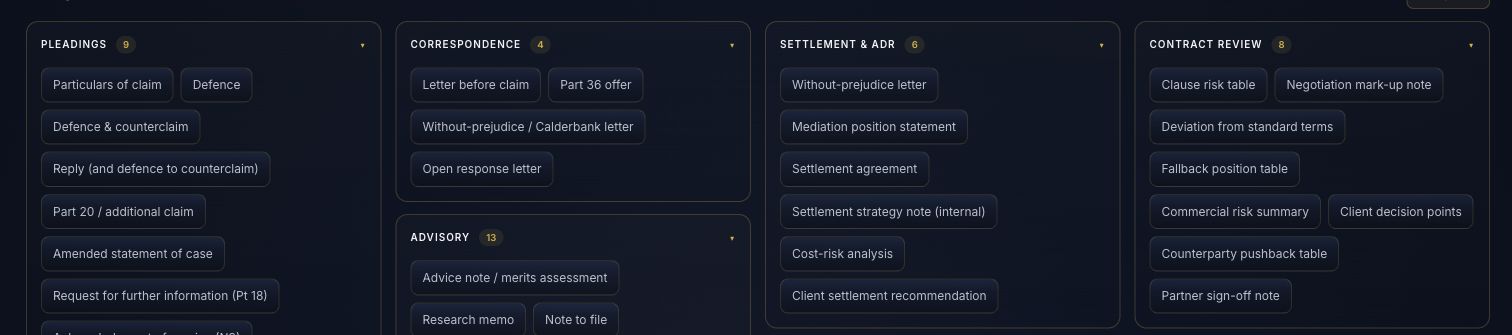
Awatum's Studio turns the context of a matter into work you can use: letters, forms and other documents, with missing details and review checks left visible.

AWATUMDocument studioPrepare · Review · Refine
Awatum's document studio showing correspondence, advisory, settlement and contract review categories
Build

Start from the matter.

Choose the work you need. A repair problem, for example, can become a landlord letter linked to the relevant matter.

Examine

See what still needs you.

Bracketed facts, source references and quality checks stay visible. Refine the draft or translate it before use.

Keep

Make it part of the record.

Save the document with its matter and return to earlier versions as the work develops.

Screens from the working product use example data. Workspaces and available tools vary by role.

Knowing when to bring someone in

The right help,
at the right point.

Awatum helps you move a matter forward. It also shows when the stakes, a contested position or a specialist question call for a solicitor or other human support. That handoff belongs in the workflow, with the facts and documents already in view.

01 / RECOGNISE

See when the matter needs more.

A significant lease, disputed IP rights or a sensitive employment decision can require specialist review. Awatum brings that moment into the matter instead of leaving you to guess.

02 / FIND A ROUTE

Know what kind of help fits.

Where relevant, it points to practical options such as a scoped solicitor review, a fixed-fee service or free support for an individual or small business.

03 / ARRIVE PREPARED

Bring the work with you.

The account, documents, dates, sources and questions already gathered give the professional a clearer place to start.

See the product do the work

Bring a real question.
Follow it through Awatum.

The useful test is what happens after the first answer. Choose a role, a jurisdiction and a workflow. We will show how the matter is opened, examined, prepared and carried forward.

  1. 01 · demonstrate

    Watch a matter develop.

    See the relevant workspace, the questions it asks, the routes it surfaces and the work it can produce.

    A product demonstration, not a slide deck
  2. 02 · evaluate

    Test your workflow.

    For a team, agree one matter type, participants, permitted data and review criteria. Examine the output and what still needs human judgement.

    A bounded evaluation with agreed terms
  3. 03 · decide

    Choose how to use it.

    Review fit, access, responsibilities and the next step for your own work or your organisation.

    A decision grounded in the work
How the intelligence earns its place

It shows the work.
And what is still unknown.

Awatum can take a matter further because it keeps reported facts, source material, missing evidence and review status distinct. That makes the next decision easier to examine.

Missing facts stay visible.

The system asks for what it needs and shows checks still open. A document held in the workspace is not treated as proof of what it says.

Dates have a basis.

Recorded dates can be tracked. Where the event that starts a legal clock is unknown, Awatum asks you to confirm it before relying on a calculated deadline.

Documents stay reviewable.

Drafts keep their source context and outstanding details. You decide what to send or file, and when independent legal advice is needed.

See Awatum working

Bring the question.
Follow the matter.

Tell us whether you are working for yourself, your company or your clients, and which legal workflow matters to you. We will show the relevant Awatum workspace in action.

Keep your first enquiry general. We can agree a suitable way to handle sensitive material before you share it.

AWATUM · justice, for everyone
Request a live demonstration →
SYX·KRN · syntaxe reasoning core
KERN
contained, and proven
subsystem online · provable AI containment
scroll ↓
AI agents. Defined authority.

Give agents useful work.
Keep control of what they can do.

Know where sensitive data can go, which tools an agent may use, and where a proposed workflow crosses the line.

Kern checks the declared tools, data flows and permissions of an agent workflow. It produces a containment proof or a concrete leak path, with a certificate your engineers can independently recheck.

One scoped workflowExplicit policy boundariesRecheckable evidence
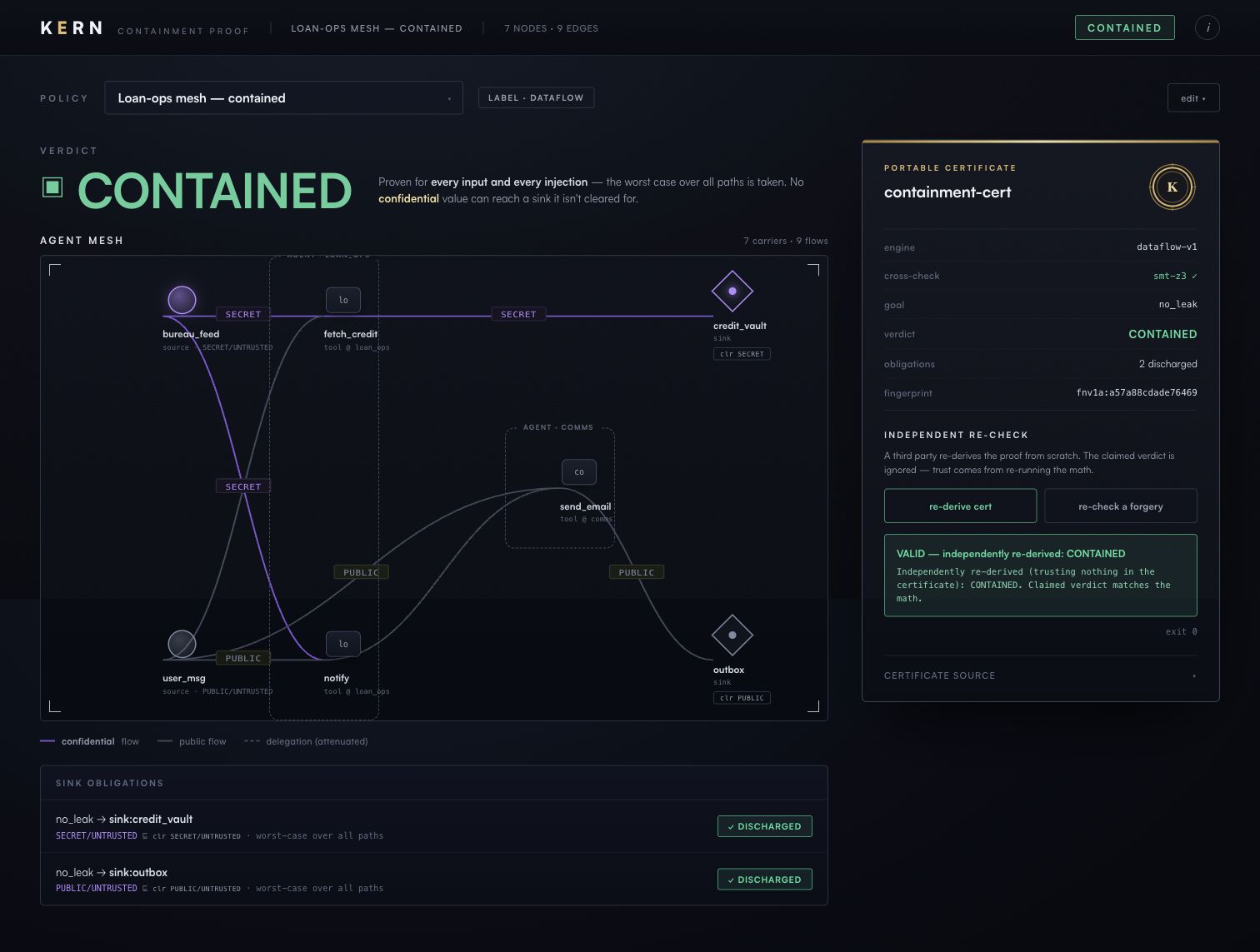
Kern loan-operations reference policy with a contained verdict, agent graph and independently rechecked certificate.
You bring

An agent workflow, its tools and permissions, and the data it must protect.

We establish

A reviewed policy boundary, a containment result and the integration conditions.

You decide

Fix the exposed route, proceed to controlled enforcement, or stop with the reason recorded.

See the difference a boundary makes

A result you can inspect.
A route you can fix.

A green verdict is only useful when you know what it covers. A failed policy should show your team where to act.

01 · CONTAINED

Confirm the permitted routes.

The reference policy limits what can reach the public outbox. Kern checks the declared graph and re-derives the certificate verdict.

Contained reference policy and independent certificate check.
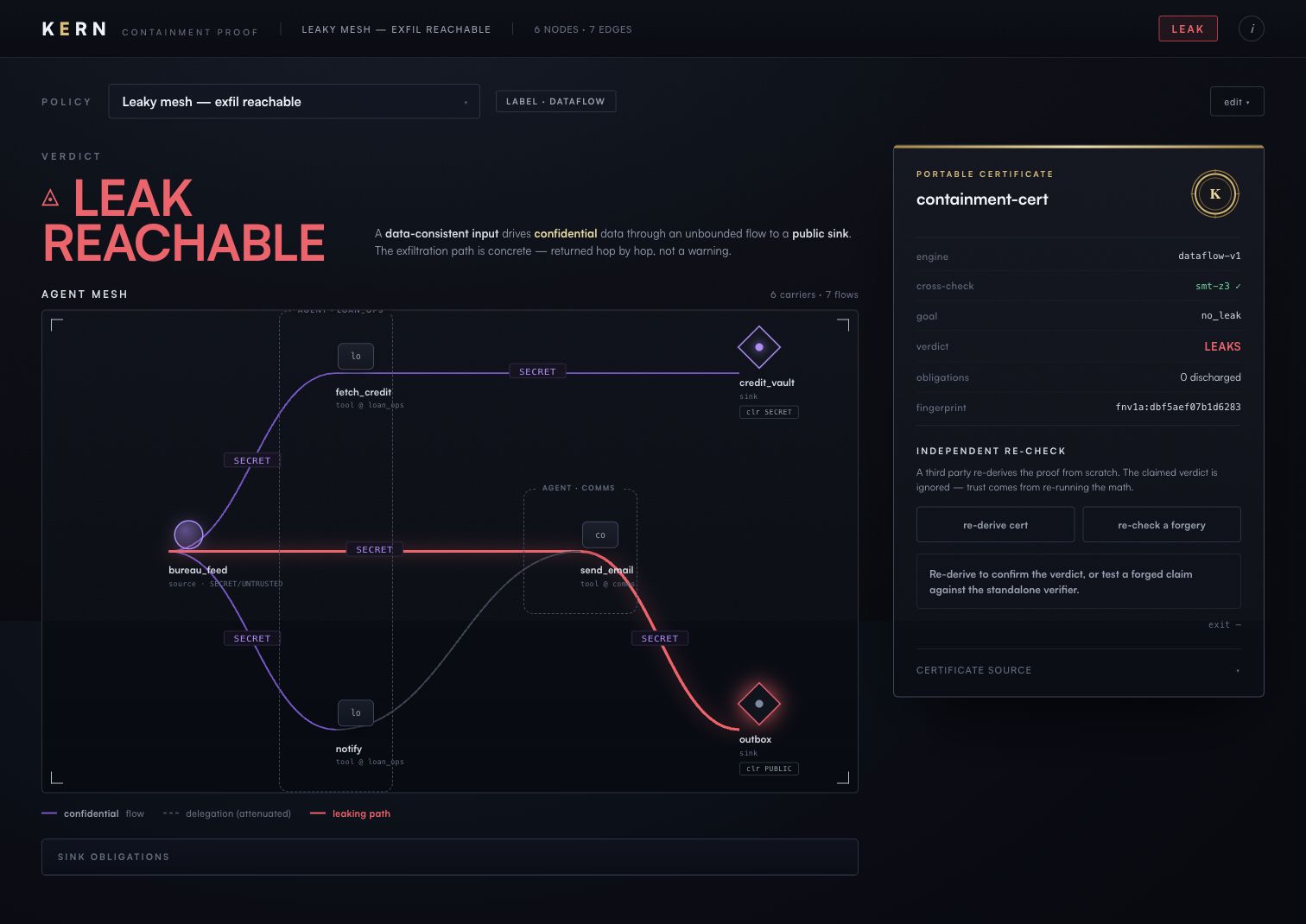
02 · LEAK REACHABLE

Find the route that must change.

The leaking reference policy permits a confidential flow towards a public sink. Kern identifies that exposure instead of granting a containment result.

Kern leaking reference policy with the exposed route highlighted.

Recorded product views using bundled reference policies. Click either view to inspect it. These results concern the declared policies, not a customer deployment.

Make the boundary explicit

Useful autonomy.
Clear permissions.
Evidence you can own.

Bring the security decision into the workflow, before expanding access.

Start with a containment pilot

One workflow.
A clear decision on the next step.

A paid, bounded engagement for teams putting AI agents to work with sensitive information. Scope, fee, deliverables and acceptance criteria are agreed before work begins.

  1. 01 · Define

    Set the boundary.

    Agree the agents, tools, data classifications, destinations and permissions. Name what is excluded.

    A reviewed policy scope
  2. 02 · Check

    Examine the routes.

    Run the policy through Kern. Review the containment result, counterexample paths and unresolved declarations.

    Evidence for the decision
  3. 03 · Recheck

    Verify the evidence.

    Re-derive the certificate independently. Record the assumptions and changes needed before runtime integration.

    A recheckable handover
  4. 04 · Enforce

    Scope the live gate.

    Agree a controlled integration test for the relevant tool calls. Demonstrate allowed and refused actions before any production decision.

    A separately agreed integration step

No production access is needed for the initial policy review. Bring a technical owner who can confirm tool behaviour and data sensitivity.

Scope your first workflow →
Where Kern fits

When an agent has access,
someone must own the boundary.

Security teams

Review sensitive data routes.

Assess whether an assistant can move protected information from an internal source to an external destination.

Platform teams

Control tool authority.

Review permissions and delegation across agents, then scope an MCP interception point for the permitted calls.

Assurance teams

Inspect the evidence.

Recheck a portable certificate without relying on the issuer's claimed verdict. Keep assumptions and exclusions visible.

From policy to runtime

Check the policy.
Control the call.

Kern includes a deterministic gate and an MCP tool-call proxy. With the declared binding in place, permitted calls can pass and forbidden calls receive a refusal.

The model does not discover every possible action on its own. Your deployment must route the relevant calls through the gate and faithfully map tools and data labels to the policy.

Illustrative containment flow

Explanatory animation, not a live execution or verification result.

What the result means

Confidence comes from
knowing the limits.

Kern proves properties of a declared model. The pilot makes the connection between that model and your workflow explicit.

Labels need an owner.

Data sensitivity, destination clearances and tool bindings need accurate human review. A proof cannot correct a false declaration.

Coverage is agreed.

The guarantee is limited to the modelled tools, routes and properties. Undeclared behaviour and unrestricted code execution are not silently covered.

Deployment is a separate check.

A policy certificate does not certify an entire platform. Runtime coverage, bypass paths and integration behaviour must be tested in the agreed environment.

Your next agent workflow

What should your agents
never be allowed to do?

Bring one workflow. We will help define the boundary and the evidence needed to move forward.

Discuss a containment pilot →
SYX·ANL · syntaxe reasoning core
ANNEAL
hardened under fire
subsystem online · adversarial security testing
scroll ↓
For security teams with a backlog to move

Which exposure
changes the attack path?

A long vulnerability list does not tell you which route through your estate matters first. Anneal connects an affected asset to exploitation likelihood, behaviour, blast radius and the path it could open.

The team can then decide what to investigate, what change to test and who can approve it.

Defined assets. Permitted signals. Named owners. No production change without approval.

Anneal demonstration console showing example exposure priorities, an attack path and asset signals.
Demonstration estate with illustrative values. Open the console to inspect it. No customer performance or validated vulnerability is represented.
From signal to owned action

Stop treating every finding
as the same problem.

A priority should be explainable. A test should stay inside its permission boundary. A fix should survive a recheck.

01 / SENSE

What changed?

Watch permitted asset signals. A first pick event, where a dormant asset is approached before active peers, becomes a specific question to investigate.

02 / SCORE

Why this exposure?

Inspect EPSS, asset dormancy, blast radius, attack surface and chain effects behind the priority. Check a CISA KEV match separately.

03 / HUNT

Can the path be tested?

Test an agreed asset snapshot in an isolated environment. Keep validation evidence, cost and the limits of the test attached.

04 / CLOSE

Did the change hold?

Test a patch, compensating control or isolation plan. A named operator reviews any production rollout.

This is the product workflow, not a claim that every stage has been deployed in a customer's estate.

One asset boundary to begin

One estate slice.
An owned route to fix.

Choose a defined part of your estate and the question behind the backlog. We review what can be observed, how priorities are derived and whether a proposed action is justified.

The first pass can use read-only inputs. Target access, adversarial testing and any change are separately authorised. Scope, fee and schedule are agreed after qualification.

Define the estate boundary →
A decision record, not another alert count
Asset and routeWhat is exposed, how it is reached and where visibility stops.
Priority rationaleThe score inputs and assumptions a security owner can challenge.
Action and approvalA patch or compensating control to evaluate, with test and rollout conditions.
Residual riskWhat remains open after the agreed recheck.
Authority is a security control

A finding does not
authorise a change.

The owner names the permitted assets, methods, environment and stop conditions. A staged remediation still needs an operator's approval before production rollout.

Closing a tested path does not certify the entire estate. Unseen assets, missing telemetry and alternative routes stay outside the result until examined.

Illustrative hardening cycle

Explanation only. No live security test or protection guarantee is shown here.

Move from alert to action

Know the route.
Own the response.

Make a security decision that engineering can test and an operator can approve.

The next security conversation

Where is the route
you cannot ignore?

Bring the estate boundary, the affected service and the decision your team needs to make.

Evaluate an estate slice →
SYX·CDC · syntaxe reasoning core
CODEC
the genome, computed
subsystem online · computational genomics
scroll ↓
Codec / research question 01

Does a cell's past add
information its present cannot?

Cells with similar measured states can follow different paths. Codec asks whether observed lineage or regulatory history improves prediction of future cell fate beyond what RNA and chromatin measurements already explain.

That is a hypothesis to test in a defined biological system, not a result the current prototype has established.

Current state: synthetic concept demonstrator. No validated biological prediction or clinical use.

THE COMPARISON PROPOSED / UNTESTED
BASELINECurrent RNA + chromatin stateHow well do the measurements available now predict a later lineage outcome?
+
HISTORY CANDIDATEObserved historyDoes measured lineage or prior state improve prediction on unseen clones and donors?
If history adds no robust value, the extra model should be rejected or simplified.
A claim must survive a fair comparison

What would make
the idea credible?

01 / Real observations

Choose one biological system.

Start with a suitable lineage-resolved dataset. Document the assay, licence, sample units, exclusions and provenance before fitting a model.

02 / Strong alternatives

Reproduce a baseline first.

Compare with simple RNA-only, RNA and chromatin, and appropriate published fate models. The added machinery must earn its place.

03 / Hard holdouts

Keep the answer unseen.

Hold out clones, donors, batches or perturbations where the data permit. Report calibration and uncertainty at the biological-replicate level.

The first programme focuses on lineage-resolved haematopoietic differentiation. The specific dataset and evaluation plan still need scientific ownership and agreement.

For computational biology collaborators

Begin with the experiment,
before building the claim.

We are looking for a research question, suitable data and accountable biological and statistical review. A collaboration starts by determining whether the proposed comparison can be made without leakage or misleading endpoints.

Describe the dataset and the biological setting in the first conversation. Do not email participant-level genomic data. Handling, permissions, deliverables and commercial terms are agreed before a commissioned study.

Discuss the study design →
PROTOCOL GATE 01Can the data answer the question?

Lineage, time and assay coverage must support the comparison.

PROTOCOL GATE 02Can we reproduce a published baseline?

Observed data and a locked evaluation split come before novel modelling.

PROTOCOL GATE 03Would the result change the conclusion?

Predefine a meaningful improvement and the failure condition.

What exists today

A research interface
awaiting biological evidence.

The current application explores cell-state ideas with synthetic states and hand-authored rules. Its animation can help explain a concept; it cannot show predictive accuracy.

No clinical, diagnostic, personal health or genome-reconstruction claim follows from it. Real-data analysis, independent evaluation and prospective experiments remain future research work.

Conceptual state dynamics

Illustration only. These are not measured cell behaviours or a validation result.

The useful outcome may be negative

Measure the gain.
Or learn that it is not there.

A research programme that can fail honestly

What would a better model
need to predict?

Bring a biological question and a candidate dataset. We can determine whether the first comparison is worth running.

Discuss a research study →
SYX·SVR · syntaxe verification system
SOVEREIGN
the original is the oracle
subsystem online · verified legacy modernisation
scroll ↓
Legacy software liberation platform

Your legacy system.
Back under your control.

Take back control of the legacy software your business depends on. Understand how it behaves, rebuild what matters and verify the replacement against the original.

Sovereign turns source, operational knowledge and executable behaviour into a route from a system you cannot safely change to one your team can understand and evolve. Start with one application. Make each next commitment on evidence.

Begin with one applicationDefined scope and feeEvidence your team can inspect

Inspect a sample dossier →   A bounded assessment is one way to begin. Already have a defined cohort and an executable original? Discuss a Verification Pilot →

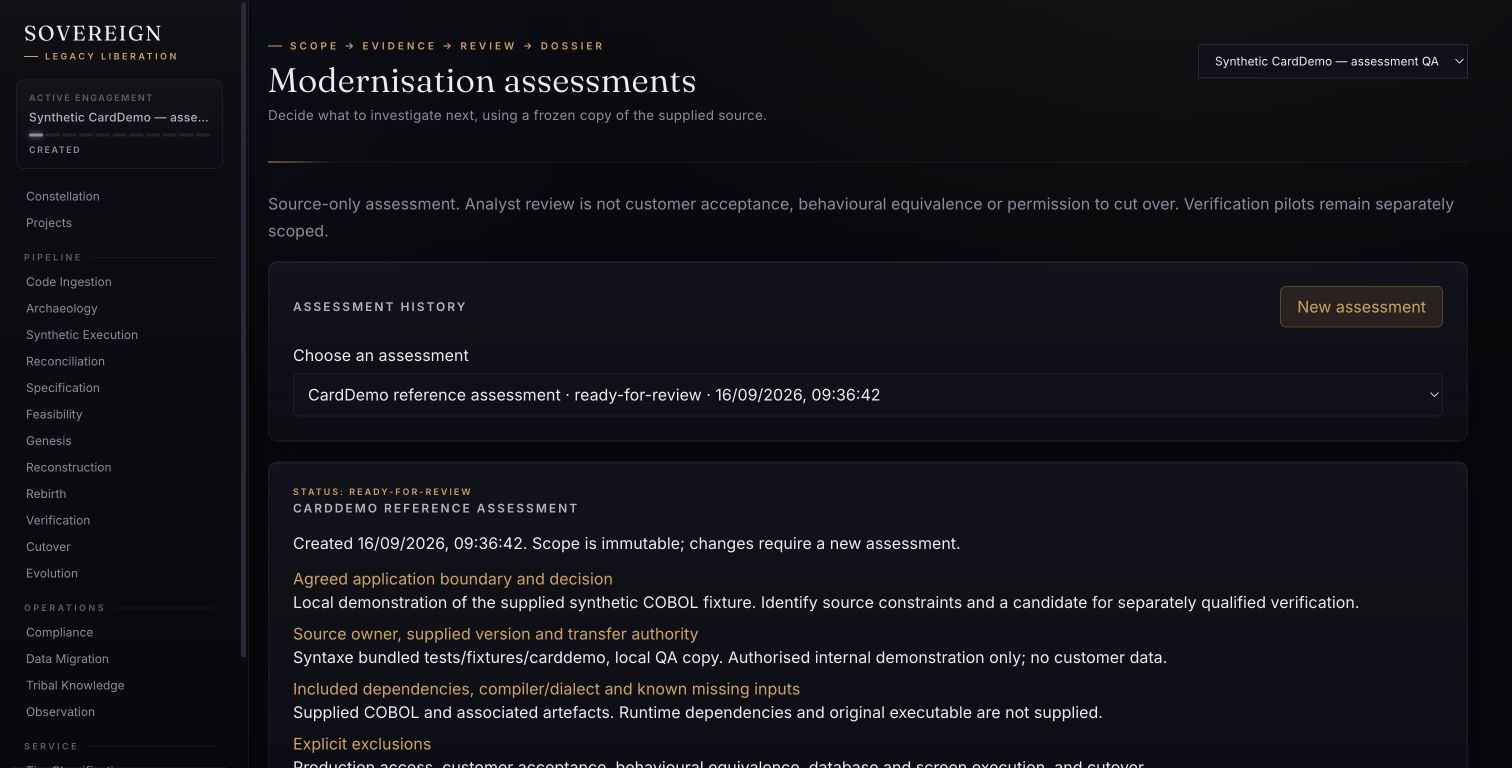
Sovereign presented on a desktop monitor in a styled workspace Real Sovereign assessment workspace showing the scope and review status of a synthetic reference application
Understand

Find the rules, dependencies and boundaries inside the system.

Verify

Compare a reconstructed cohort with the original on agreed observations.

Take control

Modernise in phases, with each decision supported by evidence.

A route out of dependency

One application at a time.
Control, earned in stages.

Begin where the evidence and your decision demand. Each stage has a defined scope and output, without asking you to commit to an estate-wide programme on day one.

  1. 01 · understand

    Map the application

    Expose the supplied system's structure, dependencies and modernisation constraints. Identify a credible first verification boundary.

    Modernisation Assessment
    Reviewed findings and a recommended next move
    Discuss an assessment →
  2. 02 · verify

    Prove one replacement

    Reconstruct an agreed cohort and compare its behaviour with the executable original on a defined set of observations.

    Verification Pilot
    Inspectable results, differences and boundaries
    Discuss a pilot →
  3. 03 · liberate

    Move in phases

    Map the wider estate, sequence viable cohorts and plan migration, operational checks and handover as separate decisions.

    Phased modernisation
    A programme scoped to your estate
    Discuss your programme →

A qualified cohort can go straight to a Verification Pilot. An assessment maps the decision; verification compares a reconstruction with the original. Production cutover follows its own readiness decision.

The original is the oracle

A new system has to earn your trust.

A rewrite is valuable only if the behaviour your business relies on survives it. Sovereign brings the original and reconstructed system into the same comparison, with agreed inputs, outputs and boundaries.

Your engineers can inspect what matched, what diverged and what remains open before a replacement carries the work.

Book a verification walkthrough →
Illustrative proof flow
Explanatory animation, not a live execution or verification result.
See Sovereign at work

From buried knowledge
to a decision you can defend.

Walk through the application boundary, source-linked findings and reviewer decisions in the product before defining your own engagement.

One application, made legible

Read the system.
Find the constraints.
Choose the route.

what you receive

Know what you have. Know what to do next.

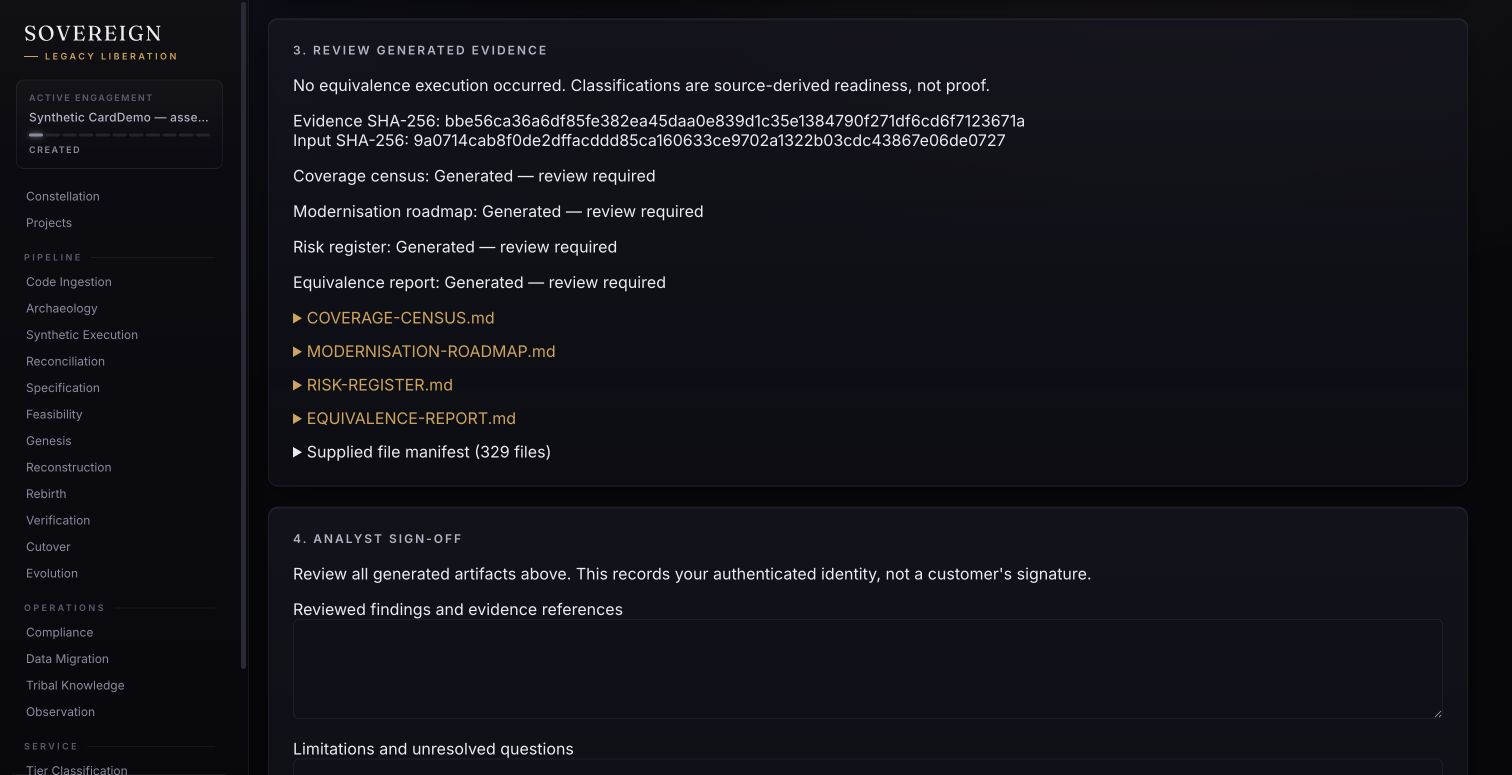
coverage census
See the application as it is
A source-linked inventory of programs, dependencies and job flows. Missing components and boundaries are visible rather than buried in an assumption.
risk register
Find the constraints that matter
Prioritised technical and access risks, each tied to evidence and an action your team can take.
roadmap
Choose a first move with confidence
A reviewed modernisation sequence and a proposed pilot boundary, including the original runtime, inputs and observations needed to verify it.
Sovereign evidence workspace presented on a laptopGenerated coverage census, roadmap, risk register and reference file manifest in Sovereign's evidence review workspace
See the system behind the decision

Know why.
Before you move.

The inventory, risk register and route forward live together. Your team can trace a recommendation back to the supplied application, examine the remaining constraints and decide what to verify next.

  • Follow the sourceFindings linked to the application provided.
  • See what is missingDependencies and access gaps kept in view.
  • Examine the judgementGenerated findings reviewed with technical owners.
Explore the reference dossier →
Explore the deliverable · reference assessment

A first deliverable you can inspect.

See a bounded application assessment before deciding whether to commission one. Sovereign generates source-linked findings; Syntaxe reviews their meaning, the constraints and the proposed next step with your technical owners.

Sovereign · Assessment Dossier

CardDemo

Bounded source-led reference assessment

Programs
44
Shared definitions
62
Batch jobs
55
Recommendation

Conditions to resolve

Qualify CSUTLDTC for a bounded pilot. Establish the executable reference and required dependencies first.

Reference findings, not a customer result.
Assessment output, not an equivalence verdict.

  1. 01 · supplySource & artefacts
  2. 02 · examineMachine-generated findings
  3. 03 · reviewSyntaxe reviewer judgement
  4. 04 · decideDossier & next step
CardDemo · reference application

One bounded legacy application and its associated artefacts. The source-led assessment identifies 44 programs, 62 shared definitions and 55 batch jobs. This reference example shows the deliverable, not a customer engagement.

Recommendation · conditions to resolve

Investigate CSUTLDTC as a bounded pilot candidate. Confirm an executable original, representative inputs and the observation boundary first. The assessment itself makes no equivalence claim.

Open the sample assessment dossier
01 · scope
What was examined
The supplied CardDemo source snapshot, including programs, shared definitions and batch orchestration. Online and database boundaries were inventoried, not executed. No original runtime or customer business acceptance evidence was supplied.
02 · inventory
What the product found
44 programs: one emission-complete candidate, 13 with named capability requirements and 30 outside the batch proof boundary. Source classification is distinct from behavioural verification.
03 · finding
A dependency to resolve
Finding R-053: CBACT01C calls COBDATFT, whose source is absent from the supplied corpus. The report cites app/cbl/CBACT01C.cbl:231. This is a source finding, not an observed runtime defect.
04 · review
What that means for the plan
Identify the missing implementation and its owner before including that caller in a pilot. Source review also identifies CSUTLDTC's call to the CEEDAYS date service at line 116. Qualify that service in both runtimes and agree inputs and observations. Emission completeness alone is not evidence of equivalence.
05 · unknowns
What remains to establish
Original executability, runtime-only dependencies, representative business cases and the commercial value of the proposed first cohort. These require the application owner's input.
06 · decision
Conditions to resolve
Qualify CSUTLDTC for a separately scoped Verification Pilot. Retain online, database and wider operational behaviour outside this batch-first boundary unless separately qualified. Do not authorise migration from this assessment.

The benefit is a concrete next action: establish the reference environment and resolve the dependency before committing to reconstruction.

Source identity and review status

Counts and the cited finding have been checked against the retained coverage census, risk register and equivalence-readiness report. The recommendation is an editorial review of those findings. This is a reference example, not a signed customer dossier.

Source snapshot SHA-256
9a0714cab8f0de2dffacddd85ca160633ce9702a1322b03cdc43867e06de0727

Equivalence: not verified
Customer acceptance: not asserted
Cutover authority: not granted

Your engagement includes machine-generated findings, review with your technical owners and an identified reviewer on the final dossier. The agreed reports and evidence are yours to retain.

Discuss your application →
how the assessment works

From source to decision. With your team in the room.

01 · scope
Agree the brief
Define the application, business decision and exclusions. Agree the fee, delivery schedule and secure source-handling arrangements.
02 · examine
Assess the application
Inventory the supplied source, trace dependencies and identify the constraints that affect modernisation and verification.
03 · review
Work with your team
Review the findings with your technical owners, resolve assumptions and prioritise the issues that matter to your business.
04 · decide
Take the next step
Receive the reviewed dossier and a recommendation: qualify a pilot, resolve a named prerequisite or change the proposed route.
is this the right starting point?

A critical system to change? Bring us the decision.

when it fits

You need to replace a legacy application, assess a proposed rewrite or move forward when the documentation no longer reflects what runs. We qualify the application, source and technical fit before proposing an engagement.

what we need from you

Tell us which system matters, why the decision is urgent and who owns it. An assessment uses authorised source and a technical owner to review findings. A Verification Pilot also needs a qualified executable original and agreed test corpus. We arrange secure transfer before you share material.

built for high-consequence change

Control the commitment. Keep the evidence.

access
Your system stays in your control
Begin with authorised source. Agree the security and access model for any later execution or verification.
scope
One decision at a time
Assessment, pilot and wider modernisation are separately scoped and priced. You choose the next commitment after reviewing the result.
evidence
A record your team can use
The agreed findings and verification evidence are delivered with their sources, boundaries and review trail.
open questions
Unknowns stay visible
Missing inputs, differences and work outside the agreed boundary are named before they can distort the next decision.
your verification pilot deliverable

The replacement earns its place. Your team sees why.

The Verification Dossier puts the original and reconstructed systems side by side: their identities, agreed inputs and observations, matches, differences and unresolved questions. Your engineers receive the evidence and rerun instructions for the agreed boundary. They can examine the result before you make the next investment decision.

Recorded reference evidence

Change the replacement. See Sovereign catch it.

In a controlled reference run, the original and reconstructed outputs matched across seven agreed inputs. An intentional change caused four differences. Sovereign rejected the altered candidate, then matched the restored version again.

01 · candidate
7 of 7 matched
Original and reconstructed process outputs matched on the agreed seven-input reference set.
02 · changed candidate
4 differences detected
An intentional output mutation produced four mismatches. The changed candidate was rejected by the comparison.
03 · restored candidate
7 of 7 matched again
Restoring the candidate restored the match under the same observation boundary.

Recorded reference execution on seven inputs, showing both a match and a detected divergence. This is a product demonstration, not a customer deployment.

Inspect the recorded identities and result
Reference: amount-guard

Original source SHA-256
df13532a43b78b0325bbb4740a291cf7190005aec9c76bd1587a5bb105776d98

Reconstructed candidate SHA-256
06d6e8a8fa8ca8a05f22267983392924ffc229daa9852af8ca6c3de53b74f20c

Mutated candidate SHA-256
b0e8c53dd0a6f6b93733301a4c866c2427f0894458b09635ce017122679a25f0

Comparison result: matched → diverged → matched
Mutation mismatches: inputs 1, 2, 25, 100
Observation: exact stdout bytes, stderr bytes and exit code
Boundary: seven integer inputs; no conclusion about other inputs, files, databases, networks or screens
Customer acceptance and cutover: not asserted
Controlled integration evidence

Retained staged live runs cover 22 named integration checks across PostgreSQL, RabbitMQ, SQL Server, Oracle, Db2 and TN3270. These support the specific paths exercised, not blanket production support or whole-application equivalence.

TN3270 evidence covers connection, protocol handshake and a decoded screen, not business transactions or screen-behaviour equivalence. The runs were staged separately, not one simultaneous full-suite execution. Detailed scope and retained evidence are available for technical review under mutual NDA.

who it's for

For technology leaders, architects and programme owners who need a critical application to change but cannot simply switch it off. Perhaps a vendor has proposed a rewrite without a comparison plan. Perhaps key rules exist only in code and operational history. If the original still runs the business, Sovereign helps your team understand it, verify a replacement and plan the move.

Bring us the system you cannot afford to get wrong.

Tell us which legacy system needs to change, what decision is in front of you and why it matters now. We will establish the right first engagement, whether that is an assessment, a defined Verification Pilot or a different route. Share source and sensitive data only after we agree a secure channel.

Discuss your legacy system →
sovereign · a syntaxe system · to be simple is to be sovereign
Discuss your legacy system →